
 Get a Quote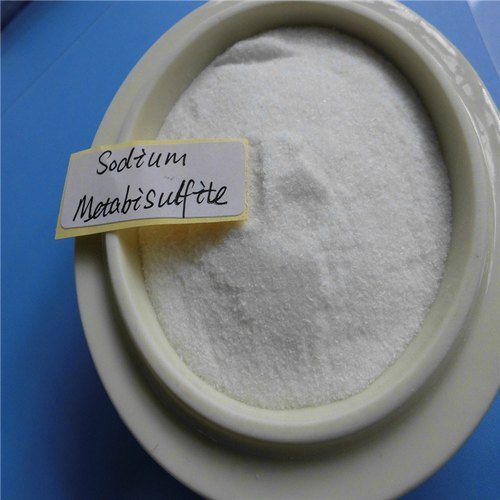
Sodium Metabisulfite
30.00 INR/Kilograms
Product Details:
- Storage Store in a cool, dry place away from moisture
- Poisonous Yes
- Taste Slightly salty
- Form Powder
- Density 1.48 Gram per cubic centimeter(g/cm3)
- HS Code 2832.20
- Molecular Formula Na2S2O5
- Click to view more
X
Sodium Metabisulfite Price And Quantity
- 100 Kilograms
- 30.00 INR/Kilograms
Sodium Metabisulfite Product Specifications
- 1.48 Gram per cubic centimeter(g/cm3)
- Sodium Metabisulfite
- Sodium Metabisulfite
- Powder
- GB 1893-2008, FCC, BP, CP
- Yes
- Slightly salty
- Industrial Grade, Food Grade
- Store in a cool, dry place away from moisture
- 231-673-0
- Inorganic Chemical
- 190.1 g/mol
- Water treatment, food preservative, photography, chemical manufacturing
- 7681-57-4
- Disodium metabisulfite, Sodium pyrosulfite
- Sulfurous
- Na2S2O5
- Industrial, food grade, pharmaceuticals
- 96% min
- Decomposes before boiling
- 150°C
- 2832.20
- Soluble in water
- 4.0 - 4.6 (1% solution)
- Na2S2O5
- Powder, crystalline
- Crystalline powder
- Stable under ordinary conditions, decomposes at high temperatures
- Not classified as dangerous goods
- 25kg woven bags with PE liner or as required
- Granular or fine powder
- 58-65%
- 2 years under proper storage
- White to yellowish crystalline powder
- Irritant to eyes, respiratory system, and skin
- 10 ppm max
- Reaction of sodium carbonate with sulfur dioxide
- 20 ppm max
- 0.5% max
Sodium Metabisulfite Trade Information
- 1000 Kilograms Per Week
- 1 Week
Product Description
We have earned huge acknowledgement in the industry through our fluent supply of premium grade Sodium Metabisulfite. The sole purpose of our company is to make sure that customers from varied sectors countrywide can always easily access and procure supreme grade of chemicals from us. We develop this antioxidant perfectly to match the quality policies in pharmaceutical formulations, food preservation and as a disinfectant. After thorough inspection, only the certified Sodium Metabisulfite are finalized for packaging and shipment by us.
A Versatile Additive for Multiple Industries
Sodium Metabisulfite is prized for its broad range of applications-from purifying water and preserving food to photographic processing and various chemical manufacturing processes. As an industrial, food, and pharmaceutical-grade product, it meets global standards like GB 1893-2008, FCC, BP, and CP, and is supplied throughout India by reputable dealers and exporters.
Stringent Quality for Reliable Performance
Produced through the reaction of sodium carbonate and sulfur dioxide, Sodium Metabisulfite boasts high purity (minimum 96%) and low heavy metal content, ensuring it meets strict safety and performance criteria. Its pH level (1% solution) ranges from 4.0 to 4.6, and it features excellent solubility, making it ideal for consistent results in your processes.
Safe Usage and Storage Guidelines
Although Sodium Metabisulfite is classified as an inorganic chemical with low toxicity, it must be handled with caution due to its irritant effects on the eyes, skin, and respiratory system. It is not considered dangerous for transport but should always be stored in a cool, dry place away from moisture to maintain stability and prolong shelf life.
FAQ's of Sodium Metabisulfite:
Q: How is Sodium Metabisulfite typically used in industrial and food applications?
A: Sodium Metabisulfite acts as a disinfectant in water treatment plants, a preservative in the food industry, and a reducing agent in chemical manufacturing. Its versatile function makes it suitable for ensuring product safety, quality, and longevity across multiple sectors.Q: What is the recommended process for safely storing Sodium Metabisulfite?
A: Store Sodium Metabisulfite in tightly sealed packaging, such as 25kg woven bags with PE liners, in a cool and dry environment away from moisture. Proper storage maintains its stability and extends its shelf life up to two years.Q: When should Sodium Metabisulfite be replaced or discarded?
A: Sodium Metabisulfite should be replaced once it has reached its two-year shelf life, especially if it shows any signs of caking, discoloration, or exposure to moisture which can affect its efficacy and purity.Q: Where can Sodium Metabisulfite be purchased and who supplies it in India?
A: Sodium Metabisulfite is widely available from chemical dealers, distributors, manufacturers, exporters, suppliers, traders, and wholesalers throughout India. Ensure that your chosen supplier adheres to recognized quality standards like GB 1893-2008 and FCC for optimal product quality.Q: What are the main benefits of using Sodium Metabisulfite in water treatment and food preservation?
A: In water treatment, Sodium Metabisulfite removes excess chlorine and acts as an antimicrobial agent. In food preservation, it prevents spoilage by inhibiting bacterial and fungal growth, thus extending the shelf life of perishable products.Q: How is Sodium Metabisulfite produced and what is its chemical structure?
A: Sodium Metabisulfite is produced by reacting sodium carbonate with sulfur dioxide, resulting in a crystalline powder with the molecular formula Na2S2O5. It has a density of 1.48 g/cm3 and a structural formula of Na2S2O5, ensuring consistent chemical properties for various uses.Q: What safety measures should be taken when handling Sodium Metabisulfite?
A: Always use personal protective equipment such as gloves, goggles, and face masks when handling Sodium Metabisulfite. Avoid inhalation of dust and direct contact with skin or eyes, as it can cause irritation. Though it is not classified as dangerous for transport, handle it with care to minimize risk.Tell us about your requirement

Price:
Quantity
Select Unit
- 50
- 100
- 200
- 250
- 500
- 1000+
Additional detail
Mobile number
Email

Other Products in 'Sodium Powder' category



"We deal in bulk inquiries only"
Contact Details

- Sf-5, Indraprasth Complex, Opp. Bharat Petrol Pump, Near Vadsar Road, Vadsar,Vadodara - 390010, Gujarat, India
- Phone : 08045803247
DRASHTI CHEMICALS
GST : 24AGLPC6288M1ZX
GST : 24AGLPC6288M1ZX

- Mr Rajesh Chauhan (Proprietor)
- Mobile : 08045803247
- Send Inquiry
 Send Inquiry
 Send Inquiry
 Send SMS
DRASHTI CHEMICALS
All Rights Reserved.(Terms of Use)
Developed and Managed by Infocom Network Private Limited.
Developed and Managed by Infocom Network Private Limited.

